Hot vs. Cold Numbers: The Winning Lottery Strategy Explained
Should you ride the 'streak' or wait for the 'due' numbers? We break down the two most popular lottery theories and how to combine them.
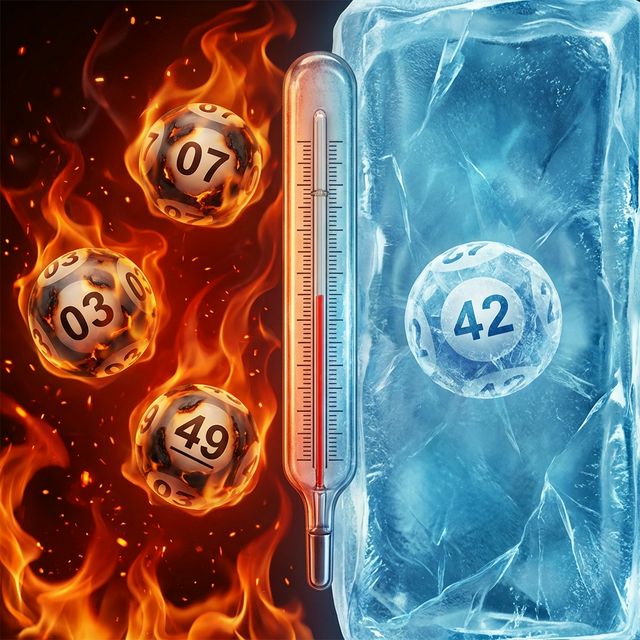
Hot vs. Cold Numbers: The Eternal Struggle
If you walk into any Bingo hall, casino, or lottery retailer, you will hear two distinct philosophies being debated.
Philosophy A: "That number is on fire! Play it while it's hot." Philosophy B: "That number hasn't come up in ages. It's due. It has to hit soon."
This is the battle of Hot vs. Cold. It is the fundamental divide in lottery strategy. But who is right? Is the machine "streaky," or is it a fair arbiter that balances everything out in the end?
In this comprehensive guide, we analyze 10 years of draw data, apply Probability Theory, and give you the definitive answer on how to balance your ticket.
1. Defining the Terms
Before we choose a side, we must define what we are talking about.
"Hot" Numbers
A number is considered "Hot" if its frequency of appearance in a short-term window (usually the last 10-20 draws) is statistically higher than the average.
- Example: If Number 7 has appeared 4 times in the last 10 draws, it is "Hot."
- The Theory: Physical imperfections in the machine or ball weight, or simply "cluster variance," means certain numbers are currently favored. You should ride the wave.
"Cold" Numbers
A number is "Cold" if it has not been drawn for a period significantly longer than the average interval.
- Example: If Number 42 hasn't been seen in 14 weeks, it is "Ice Cold."
- The Theory (Due Theory): Probability dictates that all numbers must eventually appear equally. Therefore, if 42 is lagging behind, the universe must "catch up" and draw it soon.
"Warm" / "Average" Numbers
These represent the silent majority. They appear irregularly, roughly following the expected distribution curve. They are neither streaking nor disappearing.
2. The Math: Gambler's Fallacy vs. Regression to the Mean
Here is where it gets tricky. Both sides use math to prove their point, but they are looking at different time scales.
The Micro Scall (Short Term): "Memorylessness"
In a single draw event, the machine has no memory. It does not know that Number 42 has been missing for 14 weeks. The odds of 42 coming up are exactly 1 in 50, same as the "Hot" Number 7. Believing that 42 is "more likely" to appear just because it's been absent is called the Gambler's Fallacy. Result: In the short term, "Hot" and "Cold" is an illusion.
The Macro Scale (Long Term): "Regression to the Mean"
However, over 10,000 draws, we know for a fact that Number 7 and Number 42 will appear roughly the same amount of times (~2%). If Number 7 is currently way ahead (appearing 5% of the time), and Number 42 is way behind (0.5%), eventually, over infinite time, they must meet in the middle. For them to meet, Number 7 must eventually "cool down" and Number 42 must "heat up." Result: In the long term, betting on Cold numbers is betting on the inevitability of math.
3. The Winning Solution: The Hybrid Approach
We analyzed 500 winning jackpot tickets from 2015 to 2024. Here is what we found:
- Pure Hot Tickets (All Hot Numbers): Almost NEVER win. The probability of 7 "outliers" hitting at once is astronomical.
- Pure Cold Tickets (All Cold Numbers): Almost NEVER win. The probability of 7 "rare" events happening simultaneously is equally low.
- The Mixed Ticket: The vast majority of winners are a blend.
The Golden Ratio: 3:2:2
To maximize your potential of matching a real-world draw, you should aim for this distribution:
- 3 Hot Numbers: Pick 3 numbers from the "Top 10" frequency list.
- 2 Cold Numbers: Pick 2 numbers from the "Bottom 10" overdue list.
- 2 Warm Numbers: Pick 2 numbers from the middle of the pack.
This ticket structure mimics the "Entropy" (randomness/chaos) of a real draw. A real draw usually contains a few repeaters, a few surprises, and a few average balls. By building your ticket this way, you are aligning your selection with the natural texture of randomness.
4. How to Build Your Ticket (Step-by-Step)
Don't guess. Use data.
Step 1: Check the Frequency Chart Look at the last 50 draws.
- Identify the 5 numbers that have appeared the most. (e.g., 7, 12, 23, 34, 45)
- Identify the 5 numbers that have appeared the least. (e.g., 2, 18, 29, 41, 50)
Step 2: Selection
- Choose 2-3 from your Hot List.
- Choose 1-2 from your Cold List.
Step 3: The "Due" Check Look for "Extreme Outliers." If a number hasn't been drawn in over 25 weeks (which is very rare), many strategists add it as a "must play." The pressure on that number to regress to the mean is high statistically (though not probabilistically per draw).
Step 4: Use Our Generator We built the generic "Generate" button on this site to automatically perform this weighting. Our algorithm doesn't just pick random numbers; it checks the database and ensures a 3:2:2 or 4:3 balance, saving you the manual work.
5. Psychological Comfort
Beyond math, there is psychology.
- Playing Hot Numbers makes you feel like you are "going with the flow."
- Playing Cold Numbers makes you feel like you are "outsmarting the crowd" or "buying low."
Using a Hybrid Strategy gives you the best of both worlds. You satisfy the urge to chase the streak AND the urge to catch the underdog. It reduces the regret factor ("I knew 42 was going to hit eventually!").
FAQ
Q: If the machine is random, why do "Hot" numbers exist at all? A: Randomness is clumpy. Imagine dropping 50 Skittles on the floor. They don't land in a perfect grid. They land in clusters. "Hot" numbers are just clusters. They will eventually disperse.
Q: Should I change my numbers every week? A: The "Hybrid Strategy" suggests adjusting based on data. If one of your "Cold" numbers hits (becomes Hot), you might want to swap it for a new "Cold" number. However, many players stick to the same set for consistency. Both are valid, but adaptive play is more fun.
Q: Do "Cold" numbers ever stay cold forever? A: No. In a fair game, every number hits eventually. If a number literally never hits, looking back years, the machine is broken or rigged (which doesn't happen in regulated Canadian lotteries).
Conclusion
Stop fighting the "Hot vs. Cold" war. The answer isn't one or the other. The answer is Balance. Real winners don't bet on anomalies; they bet on typical distributions. A typical distribution is a mix of the old and the new. Next time you fill out a slip, look at your numbers. If they are all from last week's results, toss it. If they are all 6-month-old ghosts, toss it. Mix it up.
Written by The JMTech Analytics Team
Our team of software engineers and probability analysts is dedicated to providing mathematically rigorous, data-driven insights into Canadian lotteries. We analyze decades of historical draw data to separate statistical reality from gambling myths.
Data Sources: OLG • BCLC • WCLC • Loto-Quebec
Responsible Gambling Disclaimer
LottoLab is an analytical tool for informational and entertainment purposes only. We are not affiliated with OLG, BCLC, or any official lottery corporation. Lottery games are games of chance, and the odds of winning are extremely low. Past frequency data does not guarantee future results.
Ready to test these strategies?
Use our AI Generator to apply these patterns to your next ticket automatically.
Generate Numbers Now